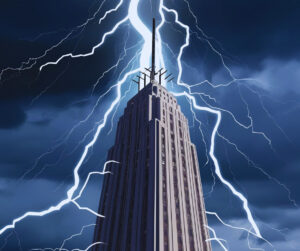
When a thunderstorm looms overhead and lightning strikes begin to illuminate the sky, one question often comes to mind: how do buildings avoid lightning? Lightning is an immensely powerful natural force, capable of causing fires, structural damage, and even fatalities. Fortunately, with advances in engineering and safety design, modern buildings employ a variety of methods to mitigate the risk of lightning strikes.
In this article, we’ll explore 8 effective methods buildings use to avoid lightning, and answer in depth the recurring question: how do buildings avoid lightning?
1. Lightning Rods: The First Line of Defense
The most well-known method is the use of lightning rods, also called air terminals. These are metal rods installed at the highest points of a building, like rooftops or towers. Their main function is to provide a direct path for lightning to follow, safely conducting it to the ground.
So, how do buildings avoid lightning with lightning rods? The answer lies in physics: lightning always seeks the path of least resistance to the ground. A lightning rod, connected to a conductor and grounding system, offers a low-resistance route, protecting the building structure from taking the hit directly.
2. Grounding Systems: Where the Electricity Goes
A lightning rod is useless without a proper grounding system. This is a critical part of the answer to how do buildings avoid lightning? Once lightning is captured by the rod, it needs to be safely discharged into the earth. That’s where grounding electrodes and conductors come into play.
Modern buildings use ground rods, grounding plates, or a grounding ring to dissipate electrical energy. A well-designed grounding system ensures the lightning’s electrical charge doesn’t linger in the structure, preventing fires and electrical surges.
3. Bonding of Metallic Structures
Another underrated strategy in how do buildings avoid lightning is metallic bonding. When a building has multiple metallic parts—such as water pipes, air ducts, metal roofs, or frames—it’s important to connect all of them using conductive cables.
Bonding equalizes the electrical potential between different parts of the building. If not bonded, lightning energy can jump between disconnected metal objects, leading to dangerous sparks or even explosions inside the building.
4. Surge Protection Devices (SPDs)
Not all damage from lightning comes from a direct strike. Often, electrical surges caused by lightning can travel through power lines and enter buildings, frying electronics and appliances.
How do buildings avoid lightning-induced surges? Through Surge Protection Devices (SPDs). These devices are installed in the building’s electrical panel to intercept and neutralize overvoltages, protecting sensitive systems like computers, HVAC controls, and security systems.
5. Faraday Cage Design
High-tech buildings, laboratories, and data centers sometimes employ the Faraday cage concept to prevent lightning damage. A Faraday cage is a conductive enclosure that surrounds and protects the internal components of a building by dispersing electrical energy around, rather than through, the interior.
This concept provides a powerful answer to how do buildings avoid lightning—by effectively creating a shield that redirects the electric energy away from sensitive equipment and people inside.
6. Use of Non-Conductive Building Materials
While not a standalone solution, material selection also plays a role in reducing lightning risk. How do buildings avoid lightning through materials? By choosing less conductive components, especially for roofing and exterior walls, builders can minimize the likelihood of attracting lightning.
For example, using ceramic tiles or composite roofing instead of metal roofing reduces the attraction to electrical discharges. However, this method is supplementary and should always be combined with an active lightning protection system.
7. Regular Lightning Risk Assessments
Prevention starts with understanding. Many modern facilities regularly conduct lightning risk assessments to determine their vulnerability. Engineers examine factors such as building height, location, local weather patterns, and structure materials.
How do buildings avoid lightning with this approach? By identifying weak points before a lightning strike occurs, facility managers can reinforce or upgrade the lightning protection system in a proactive manner.
8. Compliance with National and International Standards
A key method often overlooked is simply following codes and standards. International bodies like NFPA 780 (National Fire Protection Association) and IEC 62305 provide guidelines for proper lightning protection systems.
So again, how do buildings avoid lightning through standards? These codes ensure that designs, installations, and materials meet safety benchmarks. Buildings that comply with these regulations are statistically less likely to suffer severe lightning damage.
Why Tall Buildings Are More Vulnerable
You might wonder, do tall buildings get struck more often? Yes, absolutely. The taller a structure is, the more likely it is to be struck. However, tall buildings like skyscrapers rarely suffer catastrophic damage from lightning. Why? Because they’re engineered with robust, multi-layered protection systems, all built around the question: how do buildings avoid lightning?
From dozens of lightning rods to vast grounding grids and SPDs for every electrical circuit, these systems ensure that lightning strikes are channeled safely to the ground without harming the structure or its occupants.
Real-World Examples of Lightning Protection
Many iconic buildings around the world serve as case studies in lightning protection:
-
The Empire State Building in New York gets struck by lightning an average of 25 times per year. Yet, it has never suffered major damage thanks to its well-designed protection systems.
-
Burj Khalifa in Dubai, the world’s tallest building, employs a sophisticated network of lightning rods and grounding grids.
-
Even historical structures like churches and monuments are now being retrofitted with modern lightning protection to answer the ongoing challenge: how do buildings avoid lightning?
Lightning is unpredictable, but that doesn’t mean it’s unmanageable. Thanks to modern engineering and a deep understanding of electrical principles, buildings today are far better protected than ever before.
By combining methods such as lightning rods, grounding systems, surge protection, Faraday cages, and code compliance, the architecture and construction industries have answered the question over and over again: how do buildings avoid lightning?
Whether it’s a tall skyscraper, a residential home, or a historical monument, lightning safety is not an afterthought—it’s a core design consideration. And as our cities continue to grow vertically, ensuring every structure can withstand nature’s electrical fury becomes more important than ever.
Remember, the next time you see a lightning bolt in the sky, consider the silent technology working behind the scenes to keep buildings safe. Because when it comes to answering how do buildings avoid lightning, the answer is a mix of science, engineering, and thoughtful design.

Want to learn unique facts about how do buildings avoid lightning or another information about lightning protection solutions?
Visit www.plasmacurrent.id or contact us at +62819-9754-2715